Here's Part II in this series examining the qualities of what makes for different seniority levels of video game designers.
The Designer
Or, the time to panic is over.
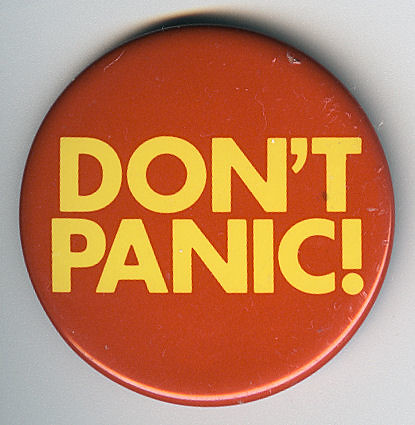
Young designers seem to be in a constant state of panic. It's all a bit exhausting for their managers. Youthful enthusiasm is greatly valued - but it often translates into making everything into a big crisis. Think of your college dorm and you know what I'm talking about. If a first playable version of a game is a creaky mess, it's a disaster. A pipeline that isn't running smoothly is a cataclysm. If players are getting lost in a level, it's a catastrophe. And if we have to go back and re-factor some work, my God was that the Fourth Horseman of the Apocalypse I saw in the break room? It must be the End of Days.
Basically, young designers have a tendency to be drama queens.
So, if you're a young designer, you probably resent what I just said and are about to go sulk about it. If you're a senior designer, you're probably smiling and laughing at yourself for how you used to go sulk in corners over these kinds of things.
And if you're on the cusp of leaving being junior behind, you probably bristled for a second there - and then let it go.
For the Designer has started to let go of their emotional over-reactions. They have enough experience in taking a design from an idea into reality to realize that birthing can be a messy process. They have seen the difference between paper ideas and practical implementation. They have a marked tendency to no over-react - or at least, not as often. They are able to express their view on a design question and support their position effectively in groups and one-on-one. They have demonstrated the ability to think clearly about a design and communicate their insight to their fellows. Finally, by this time, the Designer has developed aptitude and expertise in one of the primary disciplines (Systems, Content or Level).
The Designer works effectively as part of a team. They are comfortable in a professional environment, understanding their work is part of a larger context on the project. They participate effectively in design meetings, accepting critique and offering insight and suggestions. They've graduated from being the fly-on-the-wall or note-taker to being a participant. Maybe even leading a discussion on occasion.
The Designer is eager to demonstrate their ideas. They are looking to make their mark on a facet of a project. They are taking the initiative to present their work, advocating their design ideas. They are able to effectively pitch a design idea to more Senior Designers whether it’s in a hallway conversation or an email. The Designer is able to take minor setbacks and put them in their proper context. A Designer takes on assigned work and looks for ways to improve it or create more value from the assignment.
The primary theme for the Designer is that they have become comfortable in their role as a professional working with other professionals in a business organization.
The Senior Designer
Or, now is the time to get jaded.
This is a paradox I've found with Senior Designers - the good ones don't care as much.
Ponder that zen koan, oh young padawan.
Am I saying a good designer doesn't care? Far from it. I'm saying that younger designers have a tendency to invest everything into their work. And often, that isn't a good thing. Passion is admirable quality but it's also one that doesn't lend itself to objectivity. And it's vital for a Senior Designer to see problems clearly.
A Senior Designer has developed a level of dispassionate professionalism. They still care and strive to do their best work - but their entire being isn't riding on the next design and their worth as a human being isn't devastated by a misstep at work. And its because of this professional detachment that they can achieve their best work. It's sort of the Samurai ethos - complete commitment but detachment from the outcome. It's a state of paradox but then that's why Seniors get those big bucks.
This flies in the face of the image of Artist as tortured soul and fiery, temperamental creator. Well, besides being hard on the furniture, that kind of passion doesn't really allow for creative growth. Whatever their personal foibles, you can bet that Picasso and Hemingway and Van Gogh all had the capacity to evaluate their art with dispassion in order to make it better. And that's the same thing you want in a Senior Designer.
A Senior has a range of experiences across different design areas. They have first hand experience with system, content and level design and they’ve developed at least one of these areas to a high degree. They’ve probably developed some additional expertise – scripting/programming, art skills, writing, etc.
A good Senior keeps their cool under fire. They've gone through the development equivalent of storming Omaha Beach and raising the flag at Iwo Jima. They’ve experienced the beginning, middle and end of a project development cycle. They have personal experiences which act as points of reference for guiding future decisions while they are still able to adapt to new circumstances. Because of their combination of expertise in design and practical experience, a Senior has impeccable judgment on a project and can be significantly self-directing (something your Lead will really appreciate).
One of the most valuable traits for a Senior is the ability to work with younger Designer and mentor them. Their professional detachment allows them to effectively critique work and handle the ups-and-downs that come with passionate young designers. The Senior backs up their Lead and helps manage a project day-to-day just by being there. They have sound judgment and can be trusted with significant delegation of responsibility. They are also able to work outside the design department interacting extensively with other functional areas as well as being able to Lead cross-department ‘strike team’ style efforts. A Senior is able to identify areas in need of work and take on those assignments.
A Senior understands they are helping to set the tone for a project. When faced with uncertainty and questions, they seek answers. They offer instruction and feedback rather than criticism. Rather than being focused on problems, they are looking for solutions. Their attitude, especially in the face of adversity, helps steady the nerves of less experienced team members. When people get ready to panic, the Senior helps everybody take a breath.
The theme for a Senior is that they are a steadying influence on a project - where they go, there are less waves. A good Senior is like the eye of whirlwind - powerful but calm, all at the same time.
In
Part III of this series, we'll discuss the role of Lead Designer and Creative Director. And in
Part I we discussed being a Junior.
- Sean Dugan feels designers should be issued their towels at the start of development.
Image by Jim Linwood via Creative Commons License